Friday, September 10, 2010

Blue Jay


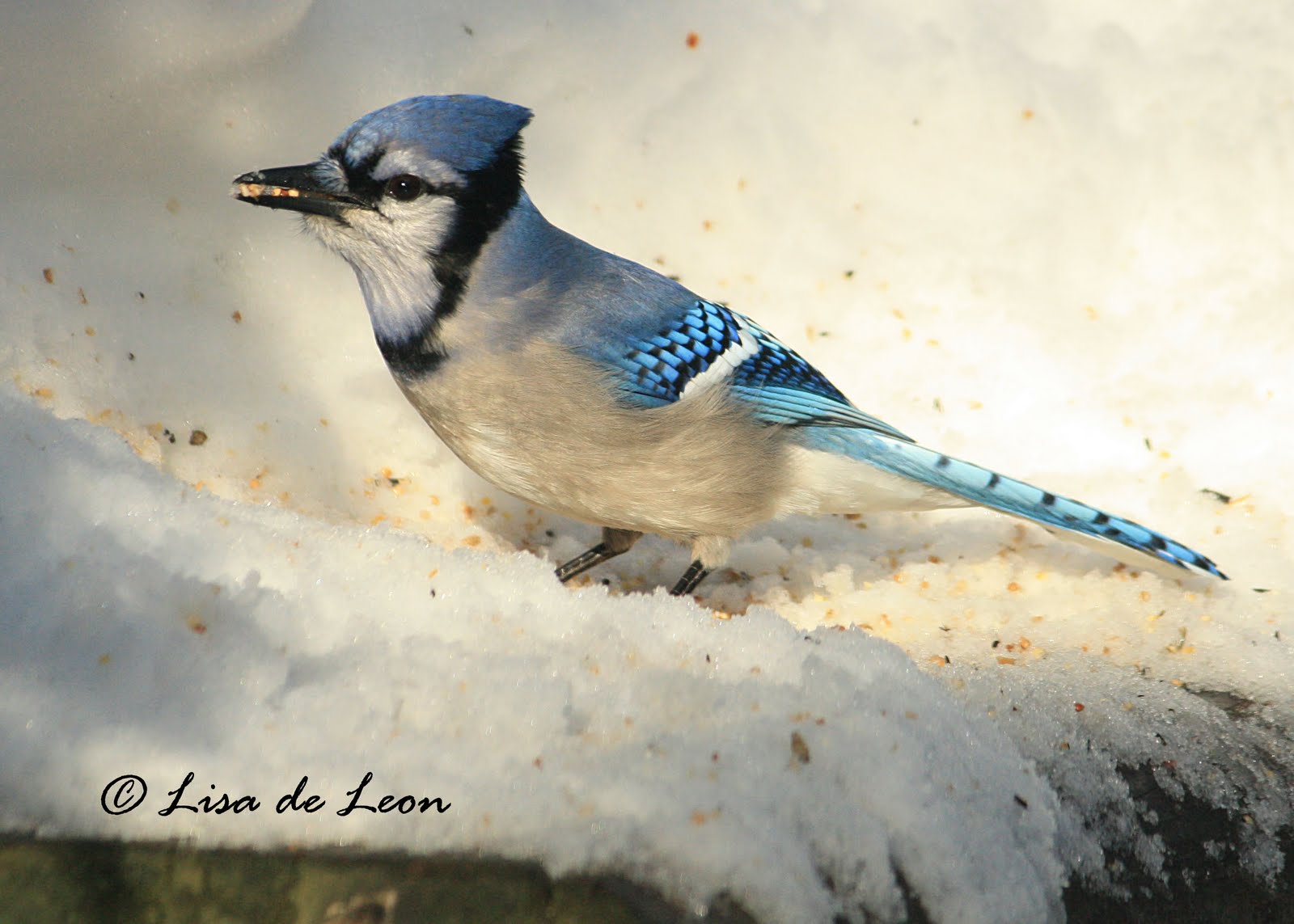
I have never really gone in search of a Blue Jay to photograph, but they are so prevalent that I don't miss a chance to snap them when I can. I have amassed a collection of Blue Jay images that cover the seasons, are local and not local, and include two juvenile Blue Jays.

Attracting Blue Jays is simple. Provide peanuts and/or bird seed mix that contains some nut pieces. They just appear to make sure to clean the dish. It was recently posted on the Discussion Group that a lady had topped up her feeder with a full bag of seed and in less than one day, a group of Blue Jays left it bare.

A Blue Jay is an extremely common, brightly colored, mid-size bird. It is particularly handsome when it has its purplish crest raised. There are many colors of blue and grey splashed over this bird. In the sunlight, it is particularly stunning. It is no wonder that Prince Edward Island adopted the Blue Jay as its official bird in 1976.
Blue Jays are social and tend to appear in groups. I found these two in my back yard having a conversation, perhaps about where they plan to dine next. The Blue Jay is akin to crows which is evident when they release a loud, piercing shriek.

I found this posing bird at Long Pond. There were two ladies who came prepared with a basket of peanuts and their cameras. Two Jays were quite accommodating. I didn't want to move in too closely on their photo shoot, but I couldn't help but snap a few shots over their shoulders.

This bathing Jay was snapped in Arkansas. It is interesting to note that the overall color of this bird is slightly different from the ones here in Newfoundland. Birds adapt to their surroundings while keeping their overall distinguishing marks.


The juvenile Blue Jay is not so handsome. It appears to be scruffy and awkward. The head is mostly black at this stage. It will evolve to have a black collar, bright blue/purple crest with a white face and chin.

It is interesting that it is the head and face that are the last to mature. The wing and tail feathers already have the clear Blue Jay markings. These shots were taking of the juvenile jay in Arkansas in July.

According to Ken Knowles via the weekly "Winging It" article in The Telegram, this Blue Jay is going through a typical molt that occurs at this time of the year. This is my first recollection of ever having seen this before. I have seen the bird in this condition for several days, although not within the last two days. Maybe the transition is complete by now. He sure looks sad.
Thursday, September 9, 2010

Carolina Chickadee


The Carolina Chickadee is very similar to the Black-capped Chickadee. The differences in color and markings are very subtle. It is difficult to tell from these images as they represent only about 5% of the original photo. I shot from such a distance and the bird is sooo small.

It is probable that if I saw both the Black-capped and the Carolina Chickadees side by side, I wouldn't be able to tell them apart. The Carolina has more grey on the chest rather than the buff color of the BCC. There is also a slight difference in the lower edge of the black bib where the one on the BBC is not as smooth as the Carolina.

To be able to distinguish the differences requires a good set of binoculars, photos and a lot of practice. How do I know that this is a Carolina? Well, it was in the South. The Black-capped Chickadee inhabits more northern and western ranges while the Carolina is found in the South. Of course, sometimes birds get confused and cross boundaries, but I think in this case, I have a Carolina Chickadee.

Boreal Chickadee


The Boreal Chickadee is more illusive than the Black-capped Chickadee. I have most often found them deeper in the woods in higher trees and more difficult to photograph. It takes a great deal of patience to wait for the little bird of its own volition to poke its head out into the light. Sometimes this happens as in this shot, and sometimes, it doesn't.


This second shot clearly illustrates the difference between a shot with good lighting and one without. It was a typical grey day and as usual, I was shooting many feet up to the top of the tree.

I have very few pictures of the Boreal Chickadee. I think I need to find this bird again.

 Updated on Nov. 3, 2010. Patience and perseverance will often yield just what you are looking for. While cruising and scanning the Southern Shore, I came across a small flock of birds near an abandoned house. There were several Northern Flickers, Black-Capped Chickadees, Blue Jays and some Boreal Chickadees.  Out of the blue a Northern Flicker landed on the top of my car. I would have loved to have photographed that.

With the sun coming and going, I was
lucky to get a moment when this Boreal Chickadee landed in a tree top  at the same moment that the sun popped out.

It was a wonder any small bird would venture to the top of a tree in the gale-force winds. How windy was it? It was windy enough the part this little bird's "hair" right down the middle. He didn't seem to mind too much and clung tight to the branch while eating.

It is thought that the food supply for this winter is going to be scarce and that we will see more small birds frequenting out bird feeders. I have laid in a supply of bird seed and bought a new winter-proof feeder in preparation for my much-anticipated visitors.


Black-capped Chickadee

Like most small birds, Black-capped Chickadees are very swift. They are relatively tame and will eat from the hand of a human, but they flit here, there and everywhere. They are a challenge to photograph because they tend to stay in the undergrowth of trees and because they move so quickly. It is also difficult to ensure that the eye is defined since it is black and blends in seamlessly with the black cap. To get this shot, I used a flash and was very lucky that this little guy stayed still just long enough.


Sometimes, it is easy to get caught up in chasing the new or rare bird to photograph. These photos of the BC Chickadee illustrate how a very pretty little, common bird can present itself in so many different settings and lighting to create a photographer's challenge any time.


Different backgrounds can accentuate the different shades of color on this bird. It is a great bird to work with to better develop photographic skills. When a good pose presents itself, it is not always easy to capture it for all time.

As I revisit and enjoy these images, I think I will spend more time trying to capture the real colors and features of this bird a little more often.

Note: I had grouped chickadees and juncos in a previous posting. Now, because of my new Bird Listing Page, I have decided to separate each species to make it easier to find specific birds.