What a contrast to the Turkey Vulture! The vulture has a wing span of almost six feet and the Ruby-throated Hummingbird has a wing span of nearly six inches. From the largest to the smallest birds observed this summer, today highlights the very small and very active female Ruby-throated Hummingbird.
It took hours of shooting to manages these few shots of this small bird. Initially, we had to set up the hummingbird feeder and lure the little ones from the neighbor's yard into my sister's yard. Within 24 hours of hanging the feeder, the hummingbirds began to circle. It was into the third day before they felt comfortable enough to come with someone sitting outside.
This little one was playing both feeders. The sugar water my sister concocted did not have any red coloring in it while the neighbor's did. This little lady came straight from the other feeder to check out the activity at ours. It still has some drops of red on its breast.
The Ruby-throated Hummingbird has an iridescent color on its back and head. This often impacts the colors that show up in images. At times the back will look very dark green or brown and in other lighting it will appear to be a very light green.
This bird flits everywhere, forwards and backwards. It can beat its wings up to 75 times a second. Think about this. It can hover in one spot for quite some time. The naked eye can't capture an image of the wings when in full motion, a camera lens at the right settings has a better chance. In this image the wings just become a blur.
In this image the hummingbird is slowing itself to land on the feeder. It was very difficult to catch any good poses or lighting because the feeder was hanging under the roof of the veranda. I had to catch the bird when I could and hope of fair lighting. I really fought with the settings on my camera in an attempt to overcome this hindrance.
To capture this image I moved out from under the covered area and shot in toward the feeder. The huge, huge trees ensured that the entire yard was in shade around the clock. I pruned some of the limbs back in an attempt to let a little light in but it didn't help much. In this shot the back looks lime green.
I was able to photograph the male of the species in the neighbor's yard (not very clear) but it never ventured into our yard. Next trip, maybe?
Sunday, August 8, 2010
Turkey Vulture
After a long drive from Little Rock to Eureka Springs, my sister and I settled into the hotel, briefly toured the downtown and had a great supper of fried catfish. (My favorite meal!)
We were still restless from being in the car most of the day so we took a short drive out of town to Inspiration Point to get a good look at the scenery. As we were clipping along, out of nowhere, two massive Turkey Vultures lifted off from their evening roadside meal.
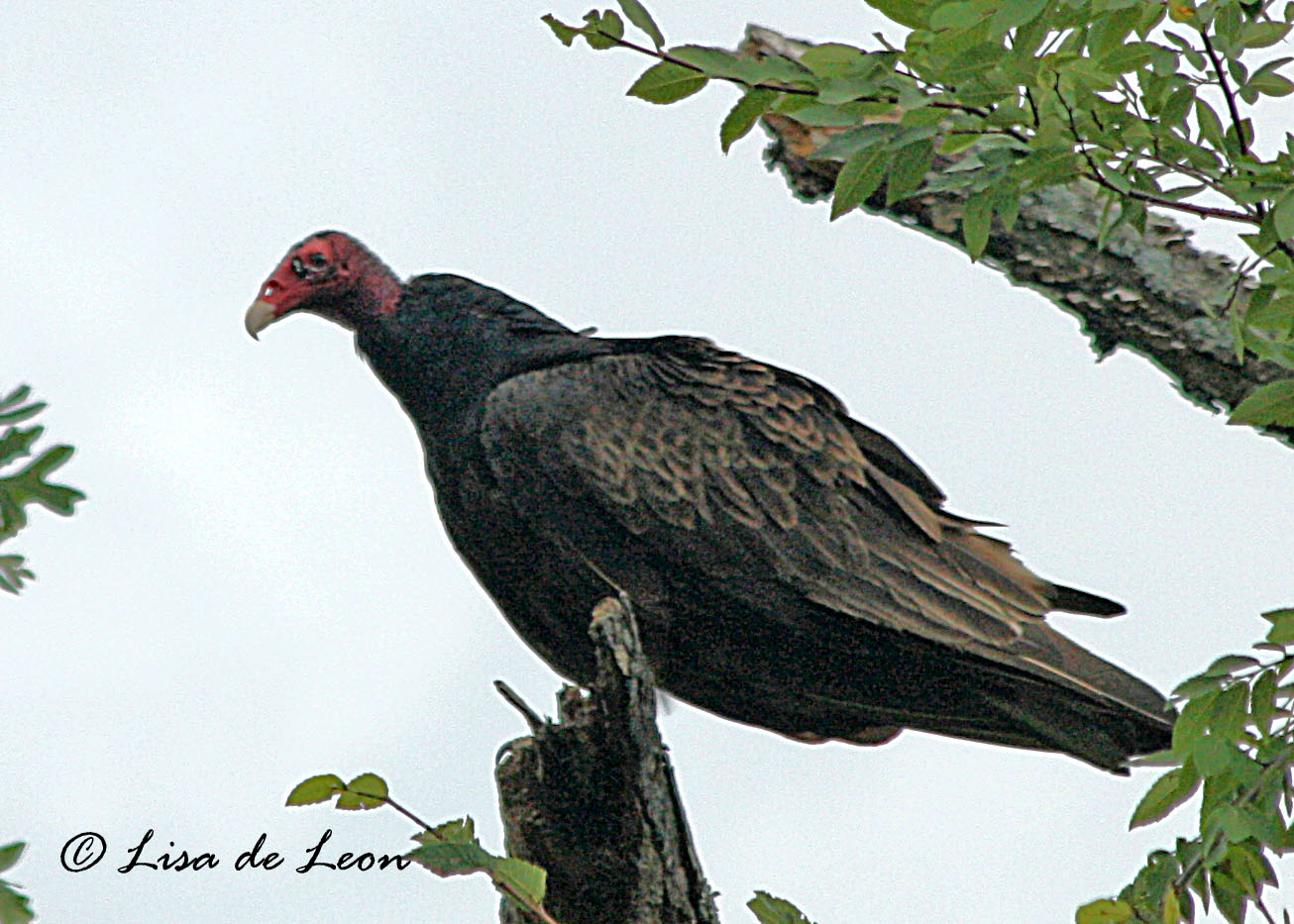
It was startling! The wing span of these birds is almost six feet. Their wings were as wide as the car as they tracked down the road in front of us for a few seconds. Needless to say, I didn't have my camera ready for this show but we were able to stop quickly and wait. It was very likely that they would return to their roadkill once things had settled down. Sure enough, they reappeared. It was very late evening and the tree-lined roadway was very poorly lighted - the story of my life. Nevertheless, I was able to snap a few pictures.
The Turkey Vulture is very common in Arkansas, most often seen in flight. There, it is often called a Buzzard. It was thought that the Turkey Vulture was a member of the raptors like hawks and other birds of prey. However, in 1994, DNA tests revealed that this bird really belongs to the stork family.
It is one ugly bird. Its head has no feathers and is red and wrinkled with a droopy eye. Yet, the sheer size of this bird held my full attention. Its beak is white, looks like ivory, with a very sharp and powerful nail at the end of it. With this beak and its talons, the Turkey Vulture can easily tear into any meal.
Although this may not be the most handsome bird, when in flight it is graceful and powerful. Despite its size and intimidating look, this bird is tame and will not kill its food. It really serves an important purpose in clearing up discarded carcasses scattered throughout the countryside.
I was hoping to see this bird with my "new" eyes during this trip, and I was not disappointed. Numerous vultures in flight crossed my path, but these two vultures in Eureka Springs were the only ones that I saw up close. It was quite a thrill.
We were still restless from being in the car most of the day so we took a short drive out of town to Inspiration Point to get a good look at the scenery. As we were clipping along, out of nowhere, two massive Turkey Vultures lifted off from their evening roadside meal.
It was startling! The wing span of these birds is almost six feet. Their wings were as wide as the car as they tracked down the road in front of us for a few seconds. Needless to say, I didn't have my camera ready for this show but we were able to stop quickly and wait. It was very likely that they would return to their roadkill once things had settled down. Sure enough, they reappeared. It was very late evening and the tree-lined roadway was very poorly lighted - the story of my life. Nevertheless, I was able to snap a few pictures.
The Turkey Vulture is very common in Arkansas, most often seen in flight. There, it is often called a Buzzard. It was thought that the Turkey Vulture was a member of the raptors like hawks and other birds of prey. However, in 1994, DNA tests revealed that this bird really belongs to the stork family.
It is one ugly bird. Its head has no feathers and is red and wrinkled with a droopy eye. Yet, the sheer size of this bird held my full attention. Its beak is white, looks like ivory, with a very sharp and powerful nail at the end of it. With this beak and its talons, the Turkey Vulture can easily tear into any meal.
Although this may not be the most handsome bird, when in flight it is graceful and powerful. Despite its size and intimidating look, this bird is tame and will not kill its food. It really serves an important purpose in clearing up discarded carcasses scattered throughout the countryside.
I was hoping to see this bird with my "new" eyes during this trip, and I was not disappointed. Numerous vultures in flight crossed my path, but these two vultures in Eureka Springs were the only ones that I saw up close. It was quite a thrill.
Saturday, August 7, 2010
Killdeer
While checking a swamp area in Arkansas this summer, I found a group of six Killdeer running around on the nearby gravel road. This is my first sighting of a Killdeer. With its striking breast bands, it is no trouble to tell that it is a member of the Plover family of shorebirds.
The Killdeer runs across the landscape very quickly but when really crowded, it will take flight. Given the reddish buff on the breast and back, I am guessing that the bird in the front of this picture is a juvenile.
Earlier in the Spring there was a Killdeer spotted in the Avalon Region. They are not a common sight here.
The Killdeer runs across the landscape very quickly but when really crowded, it will take flight. Given the reddish buff on the breast and back, I am guessing that the bird in the front of this picture is a juvenile.
Earlier in the Spring there was a Killdeer spotted in the Avalon Region. They are not a common sight here.
Domestic Crested Ducks
Among the more unusual birds that I saw in Arkansas were these two Crested Ducks. They were likely brought in for show as they were in one of Sherwood's public ponds.
It was an unexpected sight as I drove down the street and noticed the tufts rising into the air.
It had been a bland day of birding and these two unusual ducks were the highlight.
Sorting through the 2000 pictures that I have has been a daunting task. I am taking it slowly and grouping the best shots and deleting the not-so-good ones.
There are a number of birds that I have yet to identify. That also takes me quite a lot of time as I sift through the images in my field guides and the Internet. Enjoyable work!
It was an unexpected sight as I drove down the street and noticed the tufts rising into the air.
It had been a bland day of birding and these two unusual ducks were the highlight.
Sorting through the 2000 pictures that I have has been a daunting task. I am taking it slowly and grouping the best shots and deleting the not-so-good ones.
There are a number of birds that I have yet to identify. That also takes me quite a lot of time as I sift through the images in my field guides and the Internet. Enjoyable work!
Subscribe to:
Posts (Atom)