Tuesday, June 8, 2010

Scarlet Tanager


Alas, the sun popped out. That is prime time to try to take pictures of birds. I decided to check out what I might find in Goulds, particularly in the yard on Petty Harbour Road where the warblers have congregated.

In this yard there are about five huge, 50 foot pine trees, and birds of all sorts have gathered in the tops of these trees. I pulled in to the parking area across the road that backs on Forest Pond and turned off the car. Within a minute I spotted something red at the top of the tree.

At first I thought some trash had blown up in the tree.  With the winds we have been having, that was entirely possible. I grabbed my binos to get a better look and there, much to my surprise and delight, was this great red bird. I didn't waste any time grabbing my camera and jumping out of the car.  Shy or not, I was going to have to go into the driveway to get any pictures. This bird was perched at the top of the tree and I was shooting straight up. The only saving grace was that the sun was shinning. With a bit of patience and luck, this great Scarlet Tanager moved into my viewfinder.

The Scarlet Tanager does not appear in the new "Birds of Newfoundland Field Guide" because it is a rare visitor to this province. Since birds with red on them are my favorite, I was so happy to see and photograph this bird.

This Scarlet Tanager is in its breeding plumage of all red with black wings and tail. Once this period passes, this bird will molt into a mixture of yellow and dull green with some red patches. To get to see this bird in its breeding plumage is very special. I am aware of about three or four sightings reported this year. 

This bird moved around a lot and stayed very high in the trees at all times. I didn't observe it singing at any time during the 30 minutes that I observed it.

I was reading that it may visit feeders that offer bread crumbs, cornmeal and peanut butter. I think I will give this a try.

Even for a casual bird watcher, be sure to have a pair of binoculars in your car or on you. If you see a flash of red, you will definitely want to get a closer look of this great bird.

Monday, June 7, 2010

Blackpoll Warbler


In the weekend Telegram, Bruce Mactavish talked about all of the warblers in the province. He mentioned that 16 regularly frequent the area. To date, I have seen ten of them. They are very colorful, small birds that tend to move around a lot and often do not sit still for a pose. 

I was able to get two pictures of the male Blackpoll on Cochrane Pond Road before it was gone and one shot of a female at Kent Pond about a week earlier.


The Blackpoll Warbler is known for its long-distance non-stop 4000 km flights (day and night) to its winter home in South America.   At first glance it can be mistaken for the Black and White Warbler. However, the Blackpoll in its breeding plumage has a black cap with no white streaking like the B&W.  There is an olive green hue on the wings.

This bird goes through a total transformation to an olive green and yellowish color once breeding season is over.  Both the male and female have pink feet but that seems to be one of the few similarities between the genders.


Sunday, June 6, 2010

Muscovy Duck

I took a drive around CBS last Wednesday afternoon when the sun came out. It is so different to drive and walk around with no particular destination in mind. It is like being in the mall on a rainy day when a clerk asks if they can help you. My usual answer is "No, thank you. I'm just browsing." That is what I am doing when I go birdwatching - finding likely places and just browsing. Time can really get away from you though, particularly on a sunny, warm day.
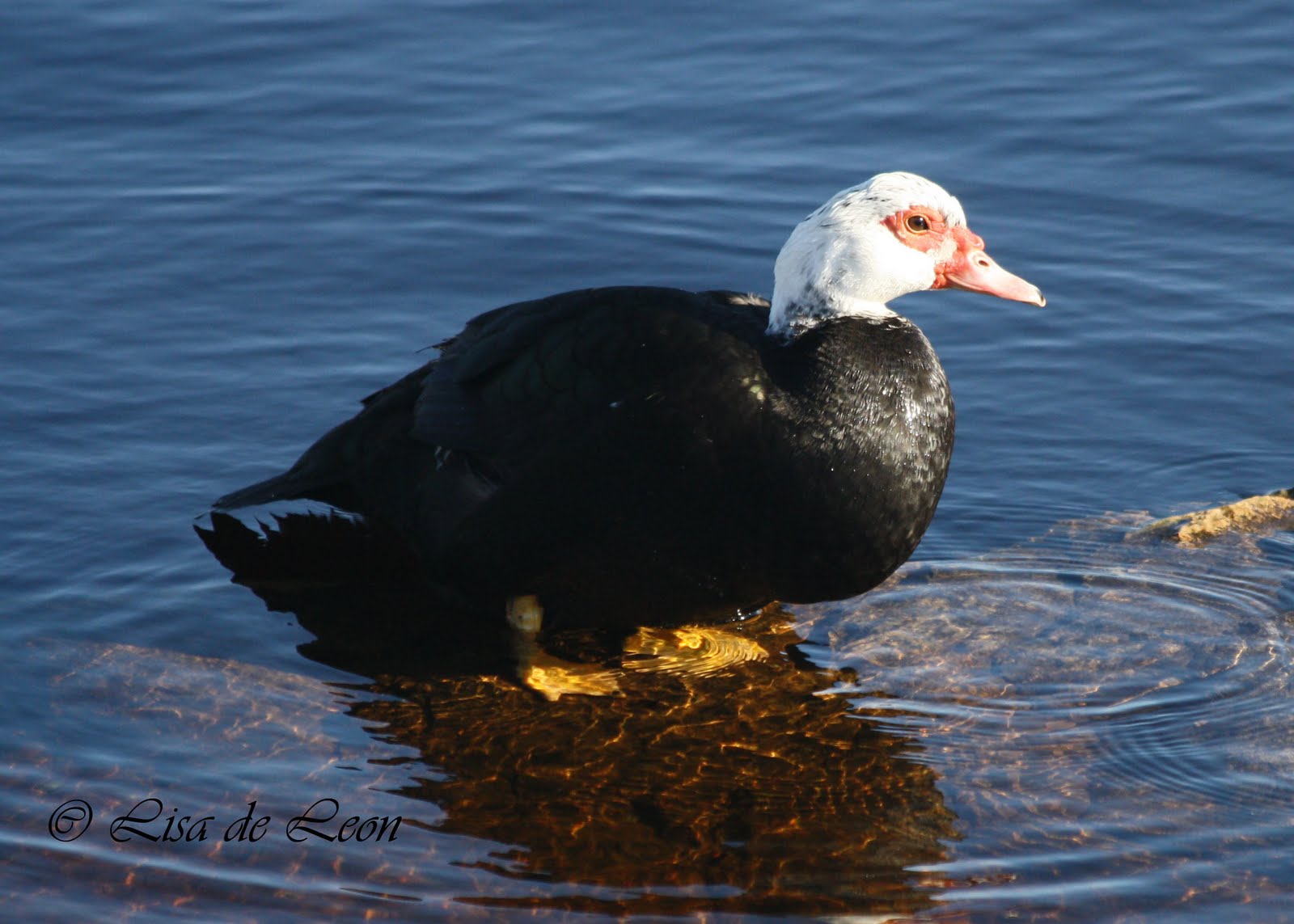
On Wednesday, I decided to explore some of the pond roads. I discovered that almost every community has a Pond Road. I believe that it was on Gully's Pond Road where I met up with this domestic Muscovy Duck.  At first I was quite excited when I noticed a different duck at quite a distance.  As I got closer, I recognized this as the Muscovy Duck.  Apparently, its owner has several and releases them in the "wild" during the Spring and Summer.


The Muscovy Duck does exist in wild flocks in Mexico, Central and South America. Nevertheless, it has been domesticated in these and other parts of the world for meat and eggs. While it may be a domesticated duck, it is still very nice to have a chance to see one here in this province.

Saturday, June 5, 2010

Common Tern


The Common Tern have returned. They can be found in ponds, lakes and around the shore. In the St. John's area I have seen the Common Tern at QV Lake (sitting on a buoy at the West end), in the harbour, at Forest Pond and Maddox Cove beach.

There are three types of terns that frequent Newfoundland and identifying them can be difficult, particularly when they are at a distance.

The distinguishing characteristics of a Common Tern, according to the field guides, are: the head and back neck are black; the outer primaries are black as seen in this picture of the spread wings; the legs are red; the bill is a reddish-orange with a black tip at the end; and the tail is forked. They are a little larger than the Artic Tern and have longer legs. It is interesting that they winter on the coast line of South America.

The call of the Common Tern is quite different from seagulls, and they are easy to isolate when among groups of gulls. They will often sit quite low on a rock or buoy that projects out of the water. Pairs seem to stay close together. Their flight patterns are swift and very different from gulls.

They use their speed to flit all around the fishing grounds. While fishing they hover above the target and wait for the right moment. It is common to see them set up several times before diving for a fish. Their true grace shows when in flight or hovering. When sitting on a rock, they look somewhat awkward and disproportionate. But not when in the air. It is really quite a show.


Once the Common Tern has a bead on its meal, it dives - sleek and straight into the water to snag a fish.

I have yet to see or at least identify the Arctic Tern or the Caspian Tern but I am keeping my eyes open for the different kind. The Arctic Tern has been spotted here by others this year.