Wednesday, March 9, 2011

Dragonflies and Butterflies

While my photo supply of new birds is dwindling, I hope to correct that early next week. Nevertheless, my hard drive is laden with pictures accumulated during my many bird watching expeditions. Today, I decided to feature a few of the insects seen last summer.




You see, it is impossible to walk by the simple sights of nature without wanting to capture them and view them over the months. Just when it feels like the 10' mounds of snow in my front yard will never dissolve, I find these pictures a great reminder that the cycle will prevail ... it always does.


Samuel Taylor Coleridge summed it up so nicely in the Rime of the Ancient Mariner when he wrote:   

"He Prayeth best, who loveth best; All things great and small; For the dear God who loveth us; He made and loveth all."


Most of us stop and look at butterflies as they flutter their bold and colorful wings in a never-ending attempt to find just the right flowers. Watching butterflies is just as engaging as bird watching for some - the varieties are many and the colors are stunning.


There are even those who are taken with watching and studying dragonflies. Is it any wonder? Look at the faces of each of these different species. They are so unique, individual and interesting that the faces of dragonflies could be integrated into cartoons, science fiction or video games.

I never really looked at the face of a dragonfly until I photographed one. They move about quickly and their face is quite small compared to the rest of the body. It is very easy to focus on the long wings or tail and miss the character of their faces.  In this photo array look closely at the third picture of the blue/green dragonfly sitting on the rocks.  It just seems that he should have a pet name. I will never miss the opportunity to photograph and study the face of all dragonflies that cross my path this summer.

Note: The tools on the posting page of this blog were not working right today. At first the pictures wouldn't upload and then the text wouldn't align properly with the pictures. Hopefully, this problem will be worked out soon.

Sunday, March 6, 2011

Around the Coastline

 It is hard to imagine that it has been almost two weeks since I took these pictures. Time flies and so did Winter. The Newfoundland Winter Bird Count has ended and the Spring Bird Count has begun. My total species sighted for Winter 2010-2011 was 85. That is low compared to the real birders on this island. In fact, one weekend birding expedition reported 63 species for just two days! I don't know how my total stacks up with last year because I really wasn't keeping good records at that time.
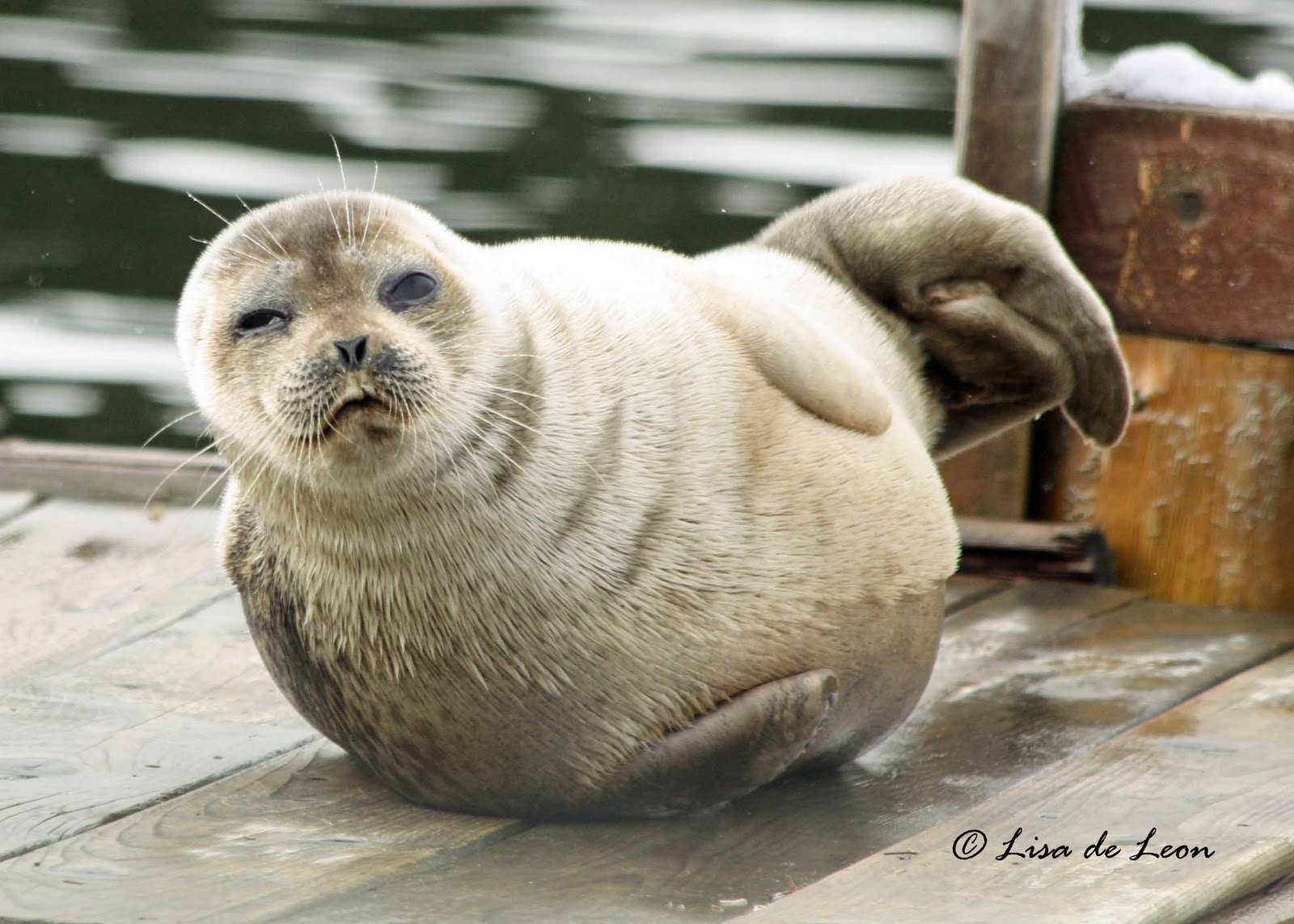
There are many indicators that Spring is just around the corner. Small birds are starting to sing, ducks and pigeons are beginning to dance and prance. Some say that seals appearing on the shoreline is yet another sign of Spring. On my recent drive around the Northern Avalon, I photographed these two seals. Any drive around this province is filled with natural excitement.  This little guy was resting on a dock in Holyrood. We stopped to have a look and he began to play a game of  "cat and mouse" with us. He would take a good look and then quickly flip back as if to pretend he
was asleep. He did this several times and was quite engaging.

It was in Cupids where we saw this big guy. He had travelled quite a distance up the beach to have his rest. Like the small one, he studied us and didn't seem at all frightened. These animals are huge. This fact is not so obvious until one is totally exposed.

It is my understanding that both of these are Harp Seals and are pretty rare on the Avalon. It is a special treat to see them. On Saturday, March 13, I saw one very large Harp Seal fishing the waters near Torbay Beach. It certainly scattered all of the birds also feeding close to shore.
If seals lying on the beach, birds singing in the trees and the groundhog not seeing his shadow are truly signs of Spring, then it can't be far away. Noteworthy:  We had sunshine for four days this week! This is the first time since last September when all of the rain washed out Fall. Let's hope for sunny, warm months ahead filled with lots of birds.

As this is Sunday, the day of rest, get off that couch and go for a drive. There is so much to see, just don't look at the price at the gas pumps as it might stifle your day.

Friday, March 4, 2011

Common Redpoll

 The Common Redpoll is common to Newfoundland and yet, for me, it has been elusive. I frequently see postings that the Common Redpoll is around, but it took me over a year to actually see one. I saw not one but six of these great little birds yesterday.
When I first spotted the red showing through some branches, I first thought it was a male Purple Finch. How nice, I thought. Then it popped out of the cover, and I realized that this was the elusive Common Redpoll. There is always a since of great discovery and satisfaction associated with seeing a new bird for the first time.
 True to its known pattern it was fraternizing with Pine Siskins and American Goldfinches. It seems that this bird is somewhat "flighty." Keeping this in mind coupled with the fact that it was on someones private property, I stayed in my car on the road and got the best pictures I could under the circumstances. It was interesting to watch the Common Redpoll jockey with the Pine Siskins for a place at the trough. There were squabbles but in the end, all got their turn.
A great place to view these birds in motion is on the bird cam hosted by the By 'd Bay Cabins website, located in Port Blantford. The Common Redpoll seem to be more numerous there now but are also moving into the city. Out with the Bohemian Waxwings and in with the Common Redpoll! Never a dull moment.

The last picture is this series is likely a female Common Redpoll because it has no color on its breast but the dark streaking indicates that it is a Common and not the rare Hoary Redpoll. I will keep a close eye on flocks of Redpolls to see if the rare variety just might be tagging along.

Thursday, March 3, 2011

SS Sposa -Conception Harbour, Newfoundland - Updated Oct. '13

While birdwatching  is really my passion, I always get a thrill when I come upon a treasure from the past, totally unexpectedly.  This was certainly the case with the SS Sposa rising above the water line in Bacon Cove, Newfoundland.

Last week a birding friend and I were scouring the Avalon North. We took a side trip to Kitchuses, a first for me. I trustingly put my faith in her knowledge of the area and drove on as per her directions. We climbed uphill and rounded a bend and there in Conception Harbour sat this great old
whaling vessel.

Automatically, my foot hit the brake and I pulled into the first available driveway. Only half off the road in a tricky location, I quickly took a couple of shots. In less than two minutes the conditions went from somewhat bright to a wall of fine snow falling between me and the target. Due to the precarious parking spot, I didn't have time to wait out the minor squall. I took in a deep breath and wondered about the story associated with this old ship.

I have since learned that the SS Sposa was one of a fleet of five whaling vessels, that formed the last of the largest whaling flotillas to hunt the waters off Newfoundland. Two other whalers (SS Southern Chief and SS Southern Foam)  rest in the waters off Bacon Cove. When the whaling industry died, so did the need for these ships.  These ships were owned by Captain J. Borgen and initially were destined to be dismantled for scrap metal. Three of the five ships were brought into this harbour. It was then decided to sink the vessels in deeper water. Two were hauled offshore and, indeed, sunk. While the SS Sposa was awaiting its turn, a storm hit the area and sank it in its place. It has been a part of the landscape ever since. It is proffered that this happened around 1964. Some residents love the wreckage for its historical significance of a time when whaling was very much a part of Newfoundland culture (although not this particular community) and others think it is an eyesore and should be removed.

While I saw no extraordinary birds on this drive, I did delve into a history of this province that I know very little about. There are tour groups in Newfoundland who provide diving tours to many of the shipwrecks that fill the waters around the coastlines of Newfoundland, including this one.  There is even a Geo caching event that takes place around these sunken ships.

This island in the North Atlantic is forever a treasure trove for birdwatchers, historians, divers, archaeologists, geologists, scientists, photographers, campers and people who just want to step out of time and embrace the beauty and intrigue of yesteryear.

Source of Information: Scratching The Surface: The Story of the Conception Harbour Ship Wrecks and the Last Whaler By Dennis Flynn  (This is a great article and can be "googled.")

Note:  Please see the comment attached by a relative of the Captain of the ship.

Link to my new post on this topic: http://retiringwithlisadeleon.blogspot.ca/2013/10/conception-bay-harbour-sunken-ship.html

There was some underwater research completed in the summer of 2013 that seems to change everything. VOCM reported the following story on their web site on October 21, 2013.

"A decades-old shipwreck mystery in Conception Harbour has officially been solved. For years, books, magazines, and newspaper accounts of the whaling wrecks have attributed contradictory names to the vessels. But now, the Shipwreck Preservation Society of Newfoundland and Labrador say they can set the record straight. Neil Burgess says through the 1960s, five whaling ships frequented Conception Harbour. Two he says were towed away, and three sunk at the wharf. The confusion surrounded which ones were which. Burgess says through underwater measurements and design details, they were able to make the match.

He says most people are probably familiar with the one ship on the beach in Conception Harbour, for years referred to incorrectly as the S.S Sposa. It has now been identified as the Charcot. Two other ships in about five feet of water behind the Charcot have been identified as the S.S Southern Foam and the S.S Sukha.

The vessels are about 120-130 feet long and which, for the most part, have been stripped of all their monetary worth. The study of the shipwrecks this summer was part of a larger project of the town to develop adventure tourism facilities. Burgess says for divers the wrecks are easy to get to because they are in shallow water close to a roadway. He says the vessels are in remarkably good shape given their age. For example, the masts are still intact, and the cabins can still be seen."

This article begs the question: Where were the other two towed and was one of them the S.S. Sposa?