The flood of migrating birds has dwindled into a trickle. No more long lists of rarities seen in one day. Nevertheless, it is just great to get out for a drive or walk. This led me to Flatrock earlier this week where I witnessed this Merlin make multiple attempts to snag a European Starling. They were just too nimble for him. He returned to the wire several times to regroup before trying again. When I left, he was still hungry.
While on this drive, I learned Bruce Mactavish had located two Hudsonian Godwit at Mundy Pond. Hmmm, I thought, I had been searching for one in the wrong places in Goulds.
By late morning, I worked my way to Mundy Pond, only to leave without seeing even one.
When I returned later in the day, there they were large as life, preening out in the open. This provided a great opportunity at close range to really look these birds over.
It quickly became apparent there is a difference in their plumage. Checking the guides this morning, I don't see any illustrations presenting exactly as either of these birds.
This is pretty typical of birds seen at this time of the year. They are in an in-between state of transition from breeding to non-breeding plumage or juvenile to adult plumage.
Now, which is which? Juvenile? Adult?
I will leave that to you to decide as I have not yet reached a decision. These last three images show a good comparison of the two birds.
Friday, October 2, 2015
Monday, September 28, 2015
Lapland Longspur
About this time every year, a few Lapland Longspur stop over at Cape Spear. Most often I have seen them in the higher grounds, but this year this arctic breeder was all alone in the lower quadrant of the grounds.
Typically when a brown bird of this size pops out of nowhere, the first thought is "Savannah Sparrow" as the park is often crawling with them. During September, another bird that comes to mind is an American Pipit, and there have been a lot of them at Cape Spear this year.
Happy to eliminate the sparrow and pipit, I was pleased to see this perfect little Lapland Longspur close-by. The temp yesterday was not warm, and I really didn't want to hike up the hill where the wind was even more raw.
The birds that just appear are really the nicest kind of "finds." The window of opportunity to see this species at the Cape is small. They predictably appear and a predictably disappear as they continue their journey south.
Typically when a brown bird of this size pops out of nowhere, the first thought is "Savannah Sparrow" as the park is often crawling with them. During September, another bird that comes to mind is an American Pipit, and there have been a lot of them at Cape Spear this year.
Happy to eliminate the sparrow and pipit, I was pleased to see this perfect little Lapland Longspur close-by. The temp yesterday was not warm, and I really didn't want to hike up the hill where the wind was even more raw.
The birds that just appear are really the nicest kind of "finds." The window of opportunity to see this species at the Cape is small. They predictably appear and a predictably disappear as they continue their journey south.
Wednesday, September 23, 2015
White-knuckle Birding
Focus, focus, focus brings surprise after surprise. Fall birding is like a white-knuckle drive: Every corner holds a surprise. What can be a nicer surprise than a stunning, male Black-throated Blue Warbler.
Following every sight and sound, Ethel Dempsey and I encountered all of these birds in just five hours of actual birding. How did that happen? Well, it takes concentration, eating on the run and taking care of nature when the opportunity arises.
Being quick on the trigger finger nailed this Yellow-billed Cuckoo. As we started our walk down Renews Beach, a large bird flushed out of the grass. It was brown on top and white, very white underneath. Without this blurred photo as it quickly departed, we wouldn't have been able to ID this bird.
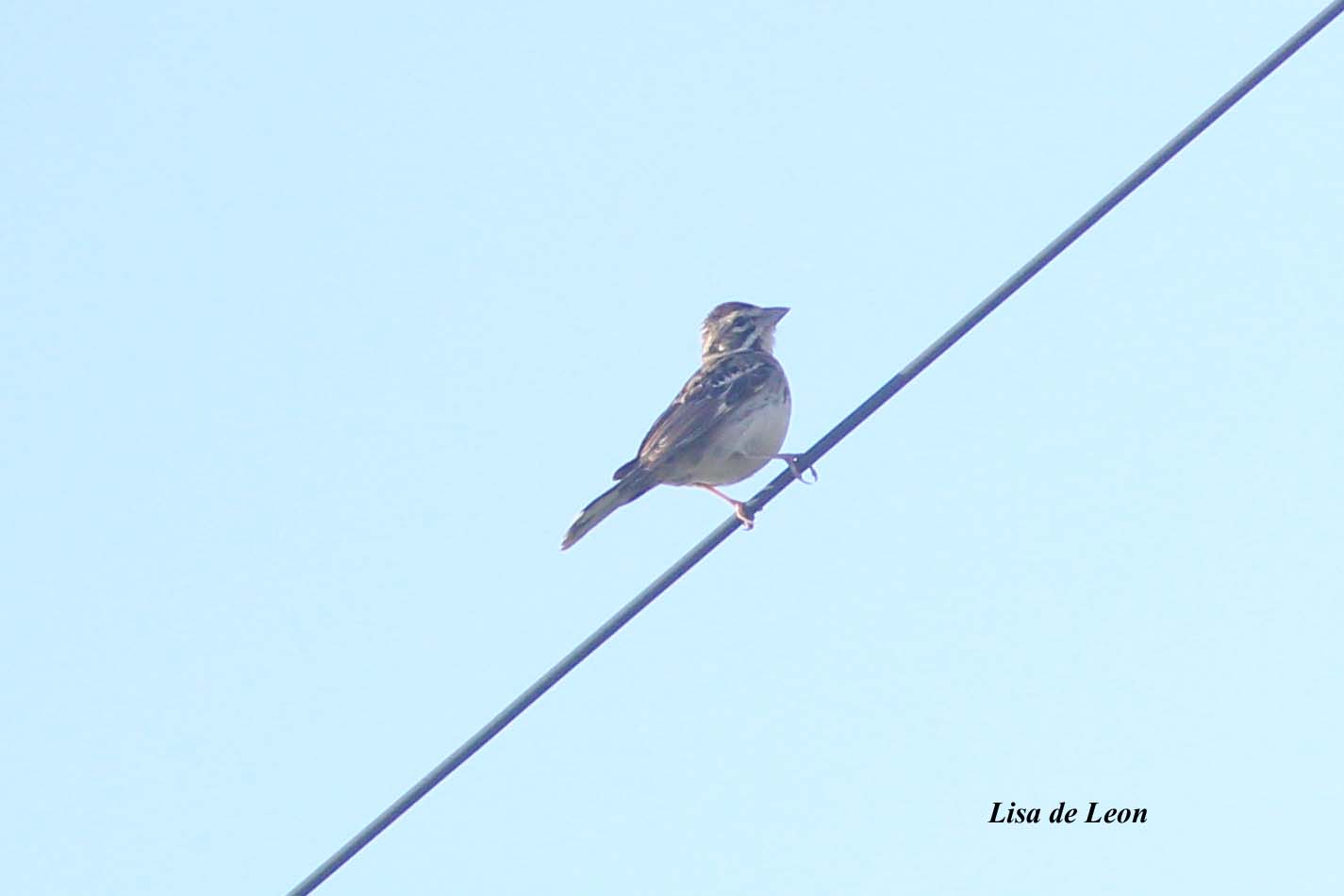
It takes checking out every bird, even the distant, small bird sitting on a wire. It just might turn out to be a Lark Sparrow. Then, it is gone.
Then, there are the unexpected bonus birds. Walking through low brush in Renews unseated this beautiful Northern Wheatear. This was the best look I have ever had of this species both in flight and perched.
It flew into the top of a woodpile where it stayed for nearly five minutes. Awesome!
This was an example of going to an area to look for another previously spotted species and turning up something even better.
Mixed in with two flocks of warblers found along the way, two Palm Warblers appeared. These are both the yellowish race which most commonly appear in the East.
This one stayed around us for a long time, kind of like the Common Yellowthroat does.
Another quick shot of a bird that whizzed past us on the beach netted a Merlin. One can't let down their guard when birding at this time of the year. Intent on seeing every bird I can and documenting it with a photo drives me to stay on the go when in an area known to be teeming with good birds.
At most every stop, we encountered Red-eyed Vireo. They seem to be mixed in with every flock. It is one thing to find all of these birds, it is another to remain unobtrusive in their presence in order for them to stay around long enough to really view them and to photograph them. These are exciting times!
Following every sight and sound, Ethel Dempsey and I encountered all of these birds in just five hours of actual birding. How did that happen? Well, it takes concentration, eating on the run and taking care of nature when the opportunity arises.
Being quick on the trigger finger nailed this Yellow-billed Cuckoo. As we started our walk down Renews Beach, a large bird flushed out of the grass. It was brown on top and white, very white underneath. Without this blurred photo as it quickly departed, we wouldn't have been able to ID this bird.
It takes checking out every bird, even the distant, small bird sitting on a wire. It just might turn out to be a Lark Sparrow. Then, it is gone.
Then, there are the unexpected bonus birds. Walking through low brush in Renews unseated this beautiful Northern Wheatear. This was the best look I have ever had of this species both in flight and perched.
It flew into the top of a woodpile where it stayed for nearly five minutes. Awesome!
This was an example of going to an area to look for another previously spotted species and turning up something even better.
Mixed in with two flocks of warblers found along the way, two Palm Warblers appeared. These are both the yellowish race which most commonly appear in the East.
This one stayed around us for a long time, kind of like the Common Yellowthroat does.
Another quick shot of a bird that whizzed past us on the beach netted a Merlin. One can't let down their guard when birding at this time of the year. Intent on seeing every bird I can and documenting it with a photo drives me to stay on the go when in an area known to be teeming with good birds.
At most every stop, we encountered Red-eyed Vireo. They seem to be mixed in with every flock. It is one thing to find all of these birds, it is another to remain unobtrusive in their presence in order for them to stay around long enough to really view them and to photograph them. These are exciting times!
Monday, September 21, 2015
Blackburnian in Blackhead
It has been a fantastic three days of birding. Rather than lamenting the three "life" birds I failed to see, I am rejoicing over the amazing birds I did see.
It really all started about a week ago, but picked up steam over the last three days. The first batch of nice vagrants I encountered was off Blackhead Road where I saw this beautiful Blackburnian Warbler in the open. At the same location, I got a glimpse and poor shot of a Northern Parula and a brief glimpse of a Black-throated Blue Warbler. The sighting of the Black-throated Blue yesterday really topped the first one by miles.
There is an on-going sense of disbelief when the great birds just keep popping out of the woods. By far this year, I am much quicker on identification, but I still rely on the experience in our birding community to confirm the rarest of birds before I post.
Why? Because migration season is so short and birders have a limited amount of time to bird. I certainly do not want to send anyone on a wild goose chase.
I have to confess finding all of these good birds is a combination of good luck, persistence and location. Looking for out-of-the way hotspots and monitoring them regularly seems to be the key.
This year, I have made a big effort to explore many roads not typically taken. The birds are here and not just in the same ole places. Habitat, time of day and persistence yields great rewards. I should add that most all of my pictures from the last two weeks are hazy. That is not a reflection on me: that is the incessant fog and overcast conditions we have had to bird in.
It really all started about a week ago, but picked up steam over the last three days. The first batch of nice vagrants I encountered was off Blackhead Road where I saw this beautiful Blackburnian Warbler in the open. At the same location, I got a glimpse and poor shot of a Northern Parula and a brief glimpse of a Black-throated Blue Warbler. The sighting of the Black-throated Blue yesterday really topped the first one by miles.
There is an on-going sense of disbelief when the great birds just keep popping out of the woods. By far this year, I am much quicker on identification, but I still rely on the experience in our birding community to confirm the rarest of birds before I post.
Why? Because migration season is so short and birders have a limited amount of time to bird. I certainly do not want to send anyone on a wild goose chase.
I have to confess finding all of these good birds is a combination of good luck, persistence and location. Looking for out-of-the way hotspots and monitoring them regularly seems to be the key.
This year, I have made a big effort to explore many roads not typically taken. The birds are here and not just in the same ole places. Habitat, time of day and persistence yields great rewards. I should add that most all of my pictures from the last two weeks are hazy. That is not a reflection on me: that is the incessant fog and overcast conditions we have had to bird in.
Subscribe to:
Posts (Atom)