Wednesday, July 13, 2011

Baby Boom - 2011

By far the most common young birds seen at this time of the year are the ducklings. Even non-bird watchers stop and enjoy the sight of ducklings imprinting on their parent or growing up and boldly striking out on their own. 
I believe all of the duckling pictures presented here to of be of American Black Ducks. They grow so rapidly so I decided to show several pictures to reflect their stages of growth.


Quite by accident I came upon this raffle of six (five shown here) poults (baby Turkeys.)  There was one white one among them but it didn't seem to get in this picture.
Hovering over the lot of babies was this very large papa. His presence was powerful enough to keep me in my car.
 I believe this to be a baby Crow, some call it a chick. Yet, when I look at it, it seems much larger than a chick.
This baby Ruffed Grouse (some call it a cheeper) was one of the more special baby finds. It was found on Bear Cove Point Road with its mother. They got separated for a little while and there was sheer panic in the call of the mother; it almost sounded like a whining, crying dog.
I believe this to be a baby Raven, although it does resemble the baby crow a lot. Not even being sure of identifying adult birds yet, I am really hard-pressed to be sure of the young version of each bird. All in good time!
 This was another very special sight to see this baby Common Loon following its parents across a large pond. While most refer to a baby Loon as a chick, loonie seems more appropriate.
Sometimes young birds can look like a whole new species. This young Dark-eyed Junco could easily be mistaken as another type of bird.  It has a distinct eye ring, its beak has not changed colors yet and there is a lot of brown streaking on its breast. However, one sure way to tell is to wait for the bird to fly and watch it flash it white tail feathers.
Seeing this young Common Tern was also quite special. I had never seen one and its white head was a real stand-out. We were unable to get too close to this bird as the adults were very effective in protecting the zone.

This young American Robin is clearly a robin but its markings are also a good clue that it has not been out of the nest very long. It is really nice to watch the young birds because they have not yet gained full control of their flying power and sometimes it takes multiple attempts to get where they want to go, kind of like a toddler.

These young seagulls were also a first for me. I have seen Black-legged Kittiwake chicks on the cliffs during bird tours but there seemed to be a mix of Herring Gull and Black-backed Gull chicks growing up on the breakwater in Conception Bay South.
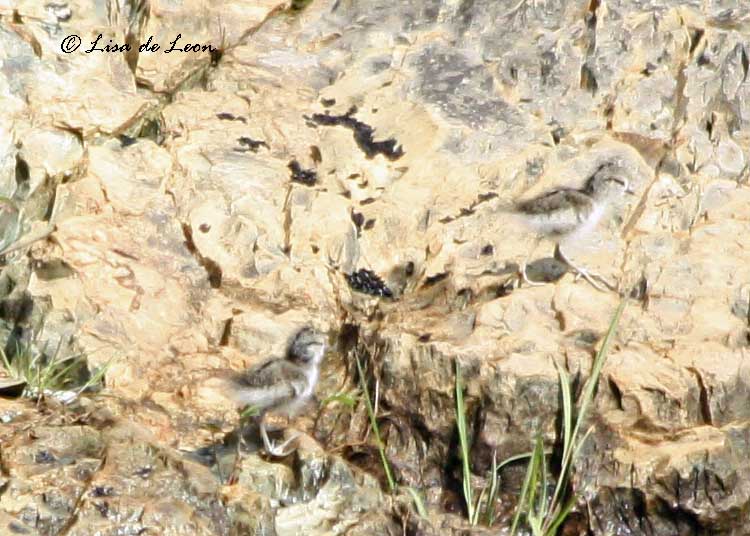
 The smallest little birds that I have seen are these little Spotted Sandpipers. Quite by accident we came upon a family of three baby Spotted Sandpipers at Cape Broyle. It was amazing how well they navigated the rocks around them.
It was not possible to get close to these little birds and that is fine because it really is a "best practice" to leave the entire family alone when there are young among them.
By contrast in size this little foal couldn't have been more than a few days old. Its legs were still a little wobbly but it looked healthy and happy as it would stay close to its mom and then venture away and then return to the safety of her side.
While in Spring we see the flowers bloom and the trees fill out with their leaves, it is at this time that most birds are just mating. Given the short period of incubation required by most birds, this is the time of the year that many fledglings appear, often guarded over by their protective parents. It offers up a whole new pattern of behaviour for a new bird watcher to study.

All of these pictures were taken over the last three weeks and were all happen chance as I did not go searching for baby birds. Nevertheless, Nature has once again offered multiple lessons in my pursuit of knowledge about the bird world.
Sunday, July 10, 2011

Hermit Thrush

It was only about two weeks ago that I saw my first Hermit Thrush. It was pointed out to me by another birder and I groaned because I didn't get a good look or any good pictures of it.

Little did I think I would have another chance in such a short time to see this bird again.
During a stop and search expedition on Bear Cove Point Road, yet another birder and I found ourselves surrounded by small birds.  Among them were many, many Hermit Thrushes.  At first there were none in sight but we could hear a loud call in the distance.  After phishing for a while in flew at least six, maybe more.  They were flying around so fast that it was difficult to count them. At one point I had a male and female in one tree.
They were very busy catching flies but rest assured, the supply of flies was not dwindling. This is a very active, loud bird and it really put on a great show. Having watched this bird so at home in its chosen habitat for such a long time, I will surely recognize it any time I see one in the future. Its call is very distinct and still rings in my ears.

Was the activity of that day an isolated event or is this the time that they are collecting food for their young? I don't know but it is notable that just two weeks ago they seemed to be around but not visible.

Friday, July 8, 2011

Mourning Warbler

With the beautiful weather of the last week, I have had a wonderful time getting out to go birding. Over the last ten days I have added had five new life birds to include:  Olive-sided Flycatcher, Hermit Thrush, Alder Flycatcher, Black Tern and Hairy Woodpecker. Each trip and each bird has been very special, BUT  no day of birding can compare to the experience that another birder and I had yesterday on the Southern Shore. I have never seen so many small birds, ever!
We started with La Manche Park where we phished a Hairy Woodpecker and many other common flycatcher, warblers and sparrows. Even though we didn't hear them, they came flying in at every phish.

We moved on trying not to stop too much with our destination being Bear Cove Point Road. We arrived after 1 p.m. and stopped to do some phishing. Again, in came lots of warblers, flycatchers and sparrows. Every place we stopped we drew in birds zooming around us.
 There were not many songs heard except for the Fox Sparrow, Purple Finch and Hermit Thrushes. We stopped in a usual clearing and walked into the woods. The Hermit Thrushes were everywhere filling their mouths with insects and calling madly. It was impossible to know where to look there were so many birds. After some regular phishing in flew this secretive Mourning Warbler. I couldn't believe my eyes. It stayed for less than 15 seconds and stayed under cover of the branches but I was able to capture a couple of record shots. This is my first Mourning Warbler of the year and I had been hoping to see one.
The Yellow-bellied Flycatchers absent on my last trip down were once again around.

On the trip we saw some baby Spotted Sandpipers at Cape Broyle and this great little Ruffed Grouse. This is a glimpse into a posting yet to come on the babies of 2011.

Even on the way home we continued to see birds including the Ring-necked Duck spotted last week, an American Bittern that flew over the car and an unknown duck with white under wings that appeared flying over a pond, lifted up over the trees and disappeared into a body of water behind the tree line. Never before have I enjoyed the array of birds seen on this trip. It was a day to remember, for sure! It was such a pleasure to share it with another avid bird watcher. Tip:  Do not go to Bear Cove Point Road without a pint of fly dope.

Wednesday, July 6, 2011

Brigus South

Many times I have driven by the exit to Brigus South. On last Sunday it became a destination and a worthy one at that. Brigus South is thought to have been first settled in 1636 by the French. The name Brigus translates into harbour of turmoil and tides. Yet, the harbour is beautiful and looks tranquil. The beach is not accessible by car which adds to its mystic and beauty.

With the capelin now in shore there were many sea birds scooping them up. Among them were Black-legged Kittiwakes, other typical gulls, Atlantic Puffins and Razorbills.

This was my first time to see Razorbills from shore. When I first walked out to the rocks, I spotted a dark-headed gull among the kittiwakes on the rocks. By the time I lowered my binoculars and raised my camera, it was gone. The head was dark....in the light it is hard to say if it was dark brown or black. I did see the legs clearly and they appeared to be a deep maroon. I walked quite far out on the rocks and sat to wait it out. After 15 or 20 minutes, it didn't return. I scanned the many birds flying around but never saw it again.


 Should anyone be going that way, keep a watch for that mysterious gull.

Ironically, I had traversed several areas of treacherous rocks without incident. On the trail returning to the car, I stepped up on a small mound to take the picture of the fishing shed above when my foot slipped on the grass. Down I went scraping the palm of my hand on a jagged rock as I tried to break the fall.

Well, my old Nemesis reared its ugly head! When I saw the blood and not knowing how deep the cuts were, I immediately put pressure on the palm of my hand and sped up in my attempt to get to the car before I got sick.

I did make it to the car and put my head down but it was too late, the sickness had a grip on me. I stumbled to the closest clump of grass before I became totally incapacitated...so weak that I couldn't even hold the keys that were in my hand. The cold sweat took over and the nausea was indescribable. This was not a first for me as it does happen about once every two years or so when I see blood, especially around the hands. Don't know why and I can't control it.

I was very grateful to have had a friend with me and two others who added some water to the cause and helped to elevate my feet. After being doused with water and with a bit of time, I began to feel better. All in all it was about 15 minutes of misery. Once it all passed, by contrast I felt so good that I was able to go on about the day as if nothing had happened. This little incident reminded me how important it is to not go out alone. It is sometimes the least expected moment when a mishap can occur.

The picture of the goose above is a Greylag Goose that has been a long-time resident of this community.

Oh, yes, I almost forgot. There is a very different structure across the harbour that is worth mentioning. It looks to be made of aluminum and was built by a man from Norway. The story goes that he came to the community and built this Norwegian cabin by the sea with no door, mind you, and returned summer after summer to reside there. Then, without notice, he stopped coming. I don't know how I missed taking a picture of that.

So there are several reasons for returning to Brigus South: 1) To find the mystery gull; 2) to take a picture of the Norwegian Cabin; 3) to see the Razorbills; and 4) to just drink in the beautiful scenery now knowing more of the history of the community.